Why Does the Double Domino Effect Require Precise Spacing?
Introduction
While watching one of Zack D. Films’ videos on the double domino effect, I became curious about how far apart dominoes could be placed while still allowing the chain to continue.
After experimenting with this in Algodoo, I noticed something surprising.
A spacing of 14.5 cm was too small for the double domino effect to occur, yet increasing it slightly to 15.0 cm allowed the entire sequence to continue.
At first glance, this seems counterintuitive. Since both values are below the maximum possible spacing, the domino effect occurs in each case. Why, then, does such a small change determine whether the double domino effect takes place?
This led me to investigate the mathematics behind the domino effect.
The problem
Consider a row of identical rectangular bricks, each of height $h$ and width $w$, standing upright and equally spaced.
If one brick is pushed, it falls and hits the next, creating a domino effect.
But this raises the question:
how far apart can the bricks be while still allowing the chain to continue, and under what conditions does the double domino effect occur?
The Geometry of a Falling Brick
Focus on a single brick rotating about its bottom corner.
As it falls through an angle $\theta$ from the vertical, the top corner moves both downward and horizontally.
The horizontal position of the top corner relative to the pivot is
$x = h \sin\theta + w \cos\theta$
The next brick begins at a horizontal distance of $w + d$, where $d$ is the gap between bricks.
For the falling brick to just touch the next one, these must be equal:
$h \sin\theta + w \cos\theta = w + d$
Rearranging gives
$d = h \sin\theta + w(\cos\theta - 1)$
This equation describes how the gap $d$ depends on the angle $\theta$ at which contact occurs.
The Maximum Possible Gap
To find the largest possible spacing, we maximise
$d(\theta) = h \sin\theta + w(\cos\theta - 1)$
Differentiating:
$\frac{dd}{d\theta} = h \cos\theta - w \sin\theta$
Setting this equal to zero:
$h \cos\theta = w \sin\theta$
so
$\tan\theta = \frac{h}{w}$
Substituting this back into the expression for $d$ leads to
$d_{\max} = \sqrt{h^2 + w^2} - w$
This is the maximum spacing for which the falling brick can still reach the next one.
A Numerical Example
In the UK, the standard dimensions for a brick are height $h = 21.5$ cm and width $w = 6.5$ cm:
$d_{\max} = \sqrt{21.5^2 + 6.5^2} - 6.5$
$= \sqrt{504.5} - 6.5$
$\approx 22.46 - 6.5 = 15.96 \text{ cm}$
So the bricks cannot be spaced more than approximately $15.96$ cm apart.
Online simulation
To test this, I simulated the system in Algodoo.
At a spacing of $15.0$ cm, the chain successfully continues:
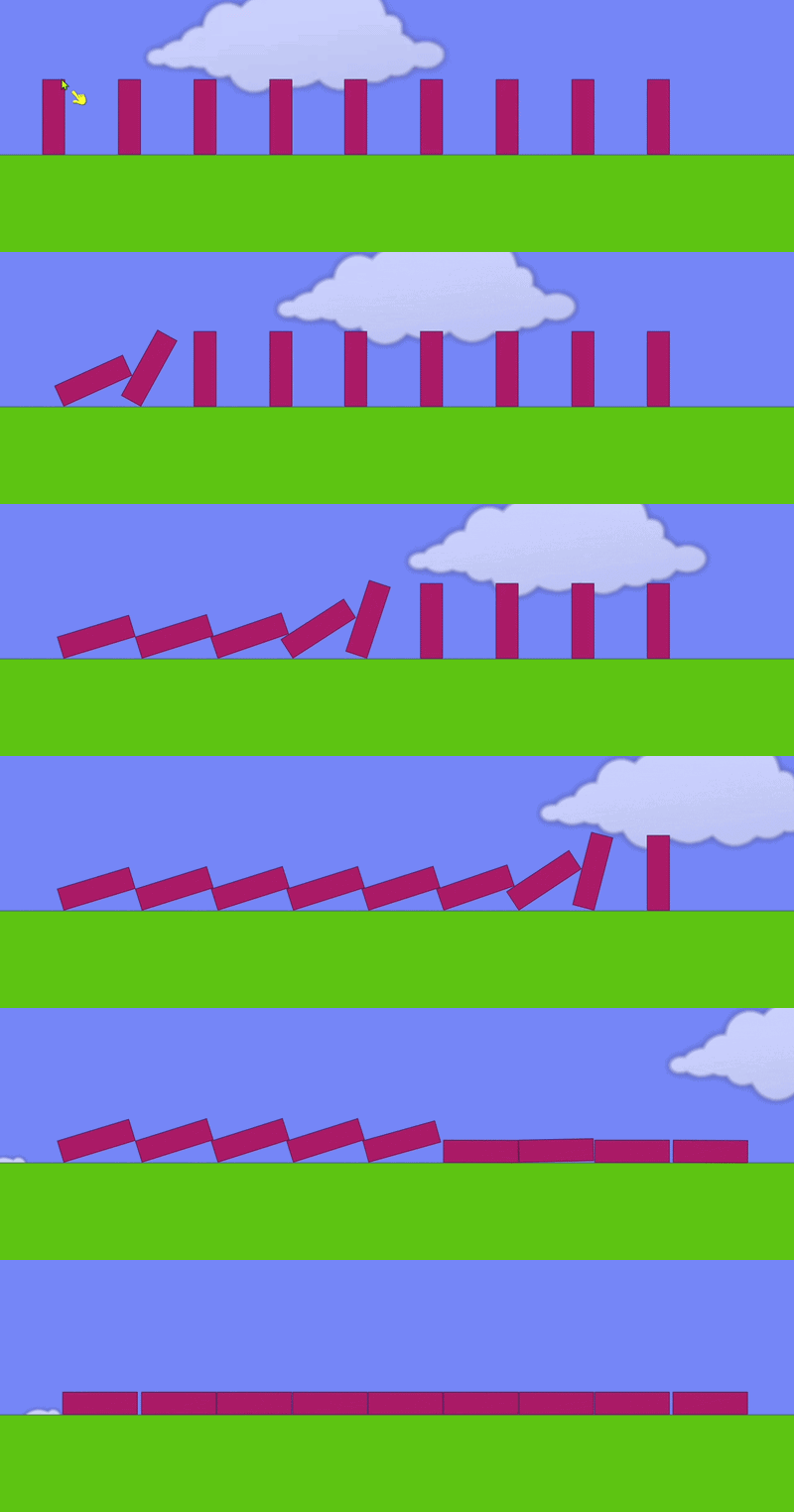
What I find interesting is that the distances between the bricks had to be very precise for the double domino effect to take place. For example, 15.0 cm distance works pretty well, but 14.7 cm was too small for there to be enough space for the bricks to fall cleanly.
Even though the simulation looks rather simple, the precision required for success took a while to fully accomplish. If you are interested in this Algodoo scene I used for this simulation, feel free to email me (more information on the About page).
Conclusion
The domino effect is not just a visual curiosity, but a combination of geometry and mechanics.
The maximum spacing
$d_{\max} = \sqrt{h^2 + w^2} - w$
comes from considering how far a rotating brick can reach.
However, the success of the chain depends not only on whether the bricks touch, but on how much energy is transferred during the collision.
This explains why the “best” spacing is often close to, but not exactly equal to, the theoretical maximum.